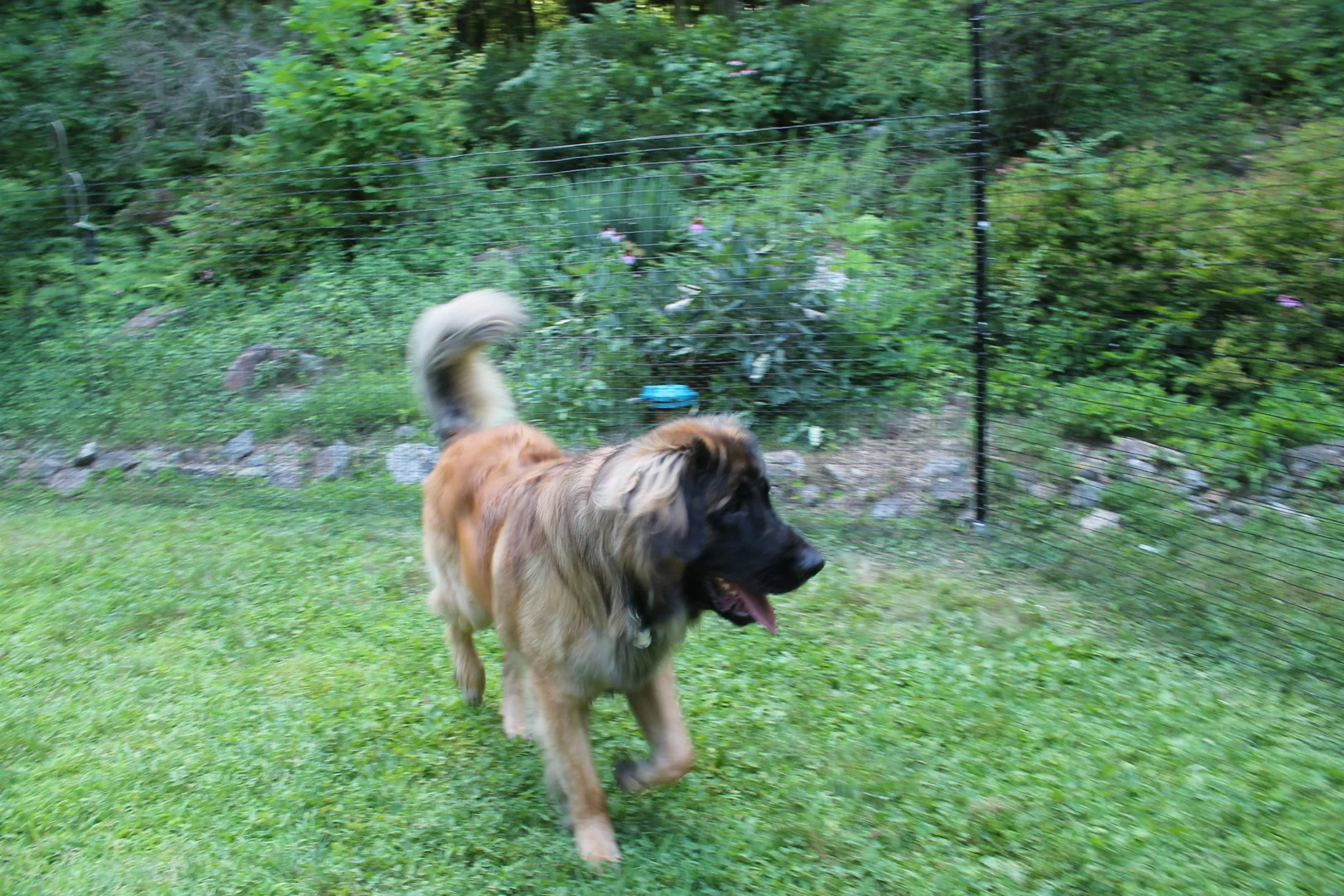
Choosing the Best Underground Dog Fence for Large Acreage
For properties of 2 acres or more, the best underground dog fence for large acreage is usually a wired system with a high-capacity transmitter, heavy-duty boundary wire, and a waterproof collar built for long battery life. Wired systems create a precise boundary through woods, hills, and irregular property lines. Top expandable options can cover roughly 25 acres, while some systems can reach up to 100 acres when more wire is added.
Before choosing a system, focus on these three points:
- Measure the perimeter, not just the acreage. A long, narrow 5-acre lot needs far more wire than a square 5-acre lot.
- Choose durable wire and waterproof splices. Large properties have more mower crossings, roots, rodents, and potential wire-break locations.
- Match the collar to your dog. Large, determined breeds need adjustable correction settings, dependable contact points, and a collar that can handle rain, mud, and swimming.
An in-ground fence can be a lower-visibility alternative to a physical fence, but it is not a barrier. It will not keep out coyotes, strangers, or other animals, and it requires consistent training so a dog understands where the safe area ends. For homeowners who want containment without electricity, digging, or a correction collar, a purpose-built physical dog fence may be the better fit.
I am Jason Levine, EMT-B, a Senior Consultant at Modern Fence Install, where I help homeowners compare discreet dog-containment options for large and irregular properties. My work includes helping clients assess whether the best underground dog fence for large acreage meets their needs or whether an engineered, non-electric steel-cable or mesh fence offers safer long-term containment.
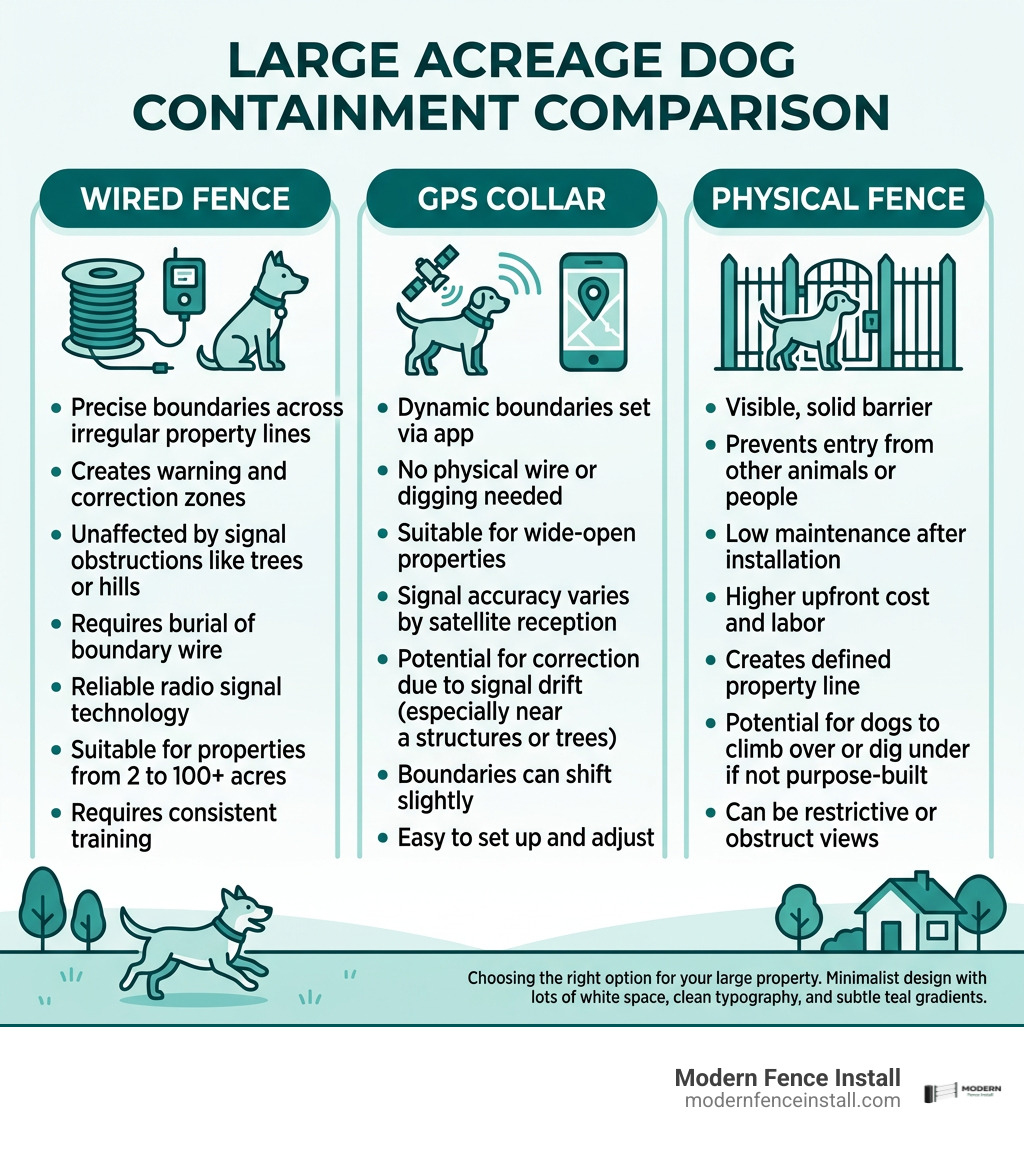
What Makes the Best Underground Dog Fence for Large Acreage?
When evaluating in-ground containment systems for multi-acre properties, residential-grade kits designed for quarter-acre suburban lots simply fall short. Large acreage demands robust hardware capable of pushing a consistent radio signal through thousands of linear feet of buried boundary line without signal degradation or phantom correction zones.
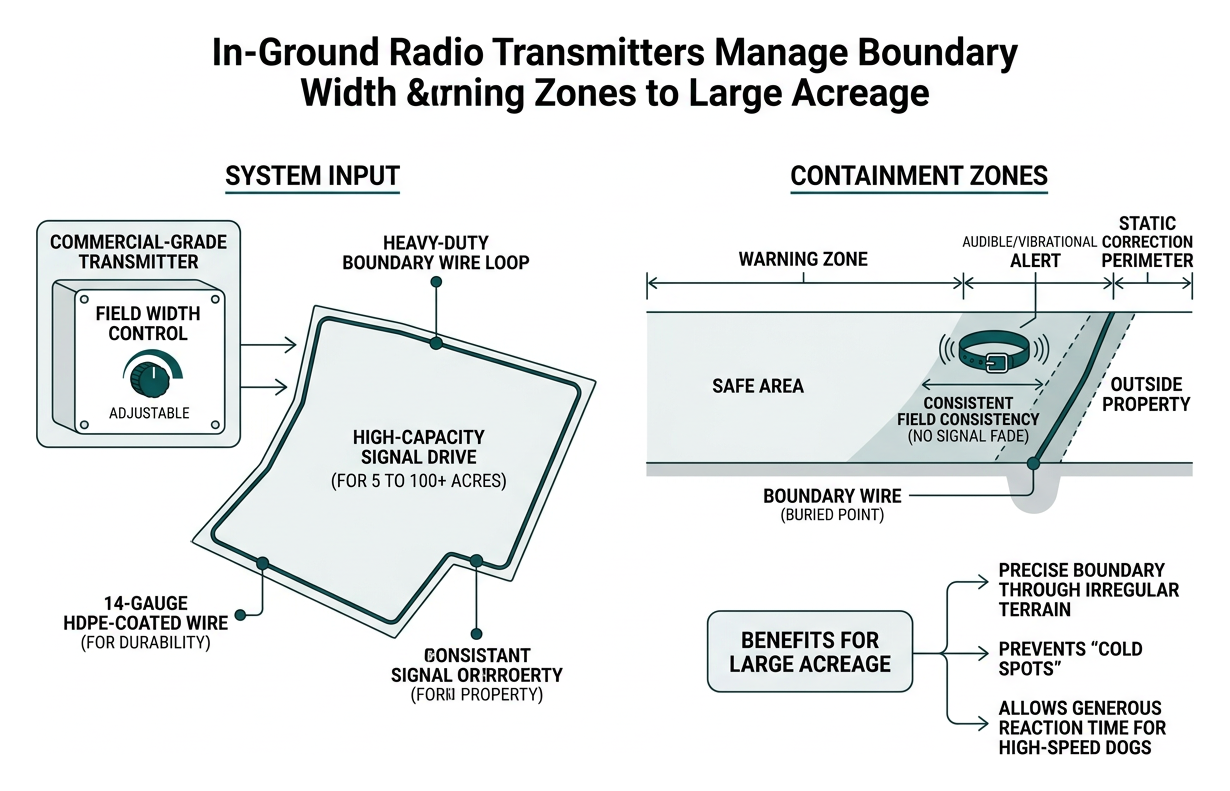
To ensure reliable, long-term containment across expansive rural land, the system you select must incorporate several critical engineering elements:
- Commercial Transmitter Power: Standard transmitters lack the output power required to drive radio frequencies through massive loops. For properties spanning 5 to 100 acres, the base station must deliver continuous, stable wattage that prevents "cold spots" or signal fade along distant boundary edges.
- Heavy-Duty Boundary Wire: Standard retail kits often include thin 20-gauge vinyl-coated wire, which is highly vulnerable to root movement, burrowing rodents, and ground freeze-thaw cycles. Expansive installations require professional-grade 14-gauge or 16-gauge solid copper wire coated in high-density polyethylene (HDPE).
- Boundary Width and Field Consistency: On expansive parcels, you need fine-grained boundary width control. This allows you to set a generous warning zone (often 6 to 10 feet wide) so high-speed dogs receive an audible or vibrational alert well before reaching the static correction perimeter.
- Built-In Surge and Lightning Protection: Long underground wire loops act as natural antennas for ground electrical surges during thunderstorms. Commercial-grade systems incorporate dedicated lightning protection modules to prevent high-voltage spikes from destroying your indoor transmitter.
- Receiver Collar Battery Longevity: Collar battery life varies dramatically across technologies. Traditional wired receiver collars range from rechargeable lithium-ion models offering 1 to 2 months per charge to replaceable battery units lasting anywhere from 3 months to 2 years.
- Multi-Dog Compatibility: A quality large-acreage transmitter should broadcast a universal frequency, allowing you to run unlimited receiver collars simultaneously, each tuned to a specific correction level for different dog sizes and temperaments.
Top In-Ground Containment Systems for Expansive Properties
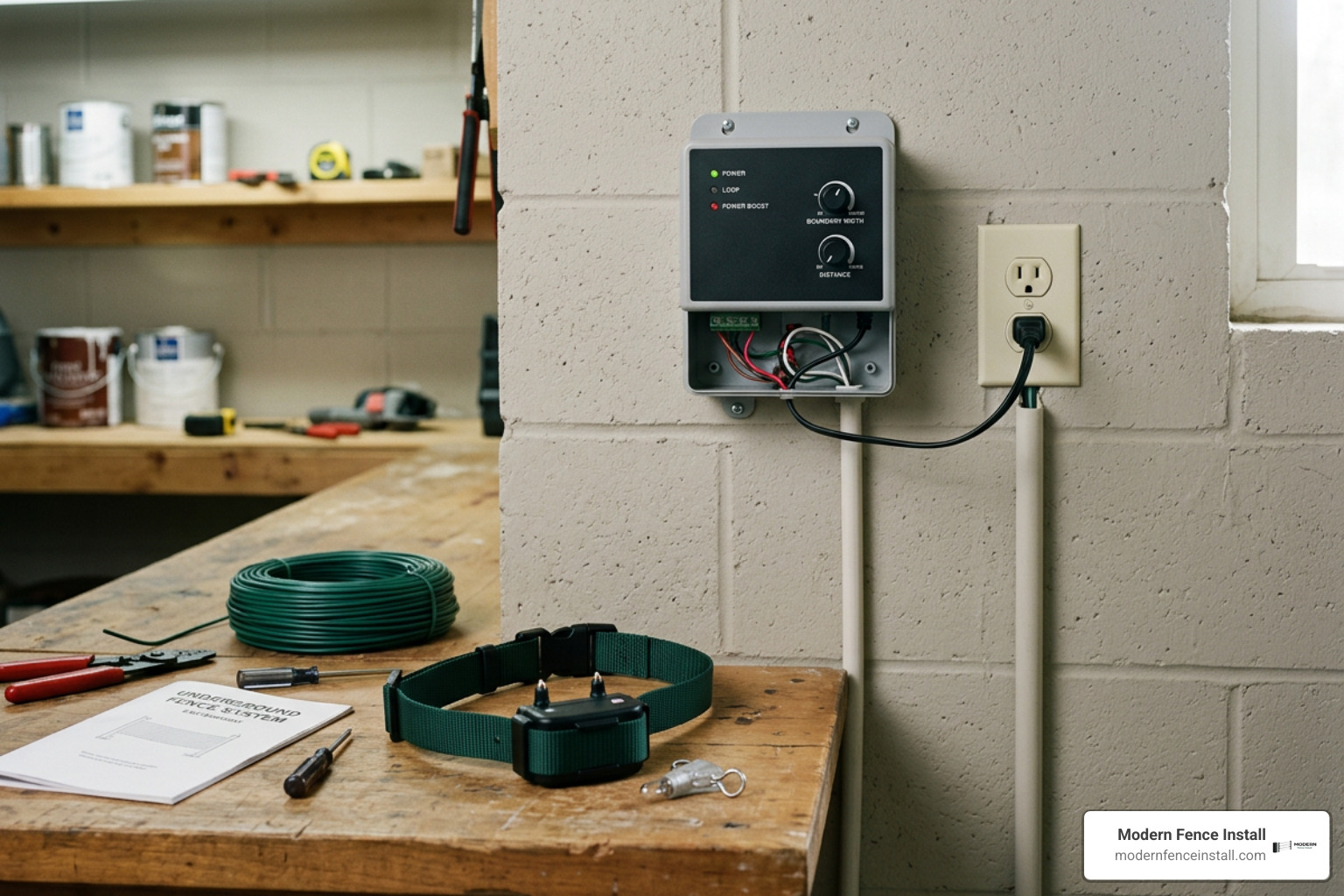
High-Capacity Systems: Choosing the Best Underground Dog Fence for Large Acreage Up to 100 Acres
For property owners managing expansive homesteads, farms, or wooded parcels, coverage scalability is the primary decision factor. A standard 1-acre square perimeter requires approximately 830 linear feet of wire, but a 10-acre parcel requires over 2,600 linear feet, and a 25-acre boundary demands more than 4,100 feet.
Leading commercial-capacity systems address these massive perimeters with high-output transmitters:
- SportDOG Underground Dog Fence System | Sporting Dog Pro : This system stands out for massive land tracts, featuring a transmitter capable of driving up to 8,600 linear feet of boundary wire to encompass up to 100 acres. The base kit ships with 1,000 feet of wire (covering roughly 1.33 acres) and features a receiver collar that charges fully via USB-C in 2 hours, offering 1 to 2 months of operational runtime per charge.
- eXtreme Underground Dog Fence | URPet 25 Acre System : Designed specifically for rural acreage, the URPet eXtreme system utilizes a second-generation commercial transmitter engineered to maintain signal strength across up to 25 acres, even through rolling, hilly terrain. The package incorporates heavy-duty, protective wire designed to resist lawnmower strikes and wildlife damage, backed by a comprehensive 10-year hardware guarantee.
- PetSafe Stubborn Dog and Pro-Grade 5-Dog Systems: Expandable up to 25 acres, these platforms are engineered to support multi-pet households seamlessly. They pair scalable signal loop capabilities with high-durability hardware, providing reliable perimeter management for active packs.
Features of the Best Underground Dog Fence for Large Acreage and Stubborn Breeds
High-drive working breeds—such as German Shepherds, Great Pyrenees, Anatolian Shepherds, and hunting hounds—often possess a strong prey drive that can lead them to ignore low-level warnings when chasing wildlife. Containing these breeds across open acreage requires specialized receiver hardware:
- Progressive and High-Output Correction Levels: The receiver collar must offer multiple intensity tiers. Progressive correction automatically increases the static impulse if a dog continues charging toward the perimeter, stopping stubborn dogs in their tracks.
- Anti-Linger Features: Intelligent collars detect when a dog is lingering in the audible warning zone to deliberately drain the collar’s battery. The system delivers a gentle correction after several seconds if the pet refuses to retreat into the safe zone.
- Rugged Waterproofing: Working dogs on large properties frequently cross mud, creeks, and farm ponds. While standard collars offer basic splash resistance, systems like SportDOG provide true submersible waterproofing down to 25 feet.
- Collar Size and Weight Dynamics: Matching the receiver to the dog's build is vital. Miniaturized units such as 1.1-ounce collars are ideal for smaller dogs, whereas heavy-duty, reinforced receivers are built to withstand the physical demands of large, active working dogs.
When managing powerful breeds that routinely challenge perimeters, understanding the best fence height for large dogs can help you decide whether an invisible barrier or an engineered physical enclosure is the right containment strategy.
Wired Underground Fence Precision and Range on Rural Land
When containing dogs on large parcels, owners frequently weigh traditional buried wire systems against modern wireless GPS containment collars. While GPS collars eliminate the manual labor of trenching thousands of feet of boundary line, wired systems deliver distinct physical advantages in perimeter consistency, particularly on heavily wooded or topographically complex parcels.
| Feature / Metric | Commercial Wired In-Ground Fence | Wireless GPS Containment Collars |
|---|---|---|
| Maximum Coverage Range | 25 to 100 Acres (Transmitter Dependent) | Up to 1,000+ Acres / Virtual Boundaries |
| Boundary Precision & Drift | Fixed (Within Inches; Unaffected by Sky) | Variable (1.5 to 10+ Foot Satellite Drift) |
| Tree Canopy & Terrain Impact | Zero Signal Loss (Radio Frequency in Ground) | Canopy, Heavy Cloud Cover, & Hills Can Degrade Signal |
| Collar Battery Life | 1–2 Months (Rechargeable) to 2 Years (Lithium) | 24 to 72 Hours (Requires Daily/Frequent Recharging) |
| Collar Weight | Ultra-Light (1.1 oz to 3 oz) | Heavier (3.5 oz to 6+ oz; Min. Dog Weight ~20 lbs) |
| Recurring Subscription Fees | None ($0/month) | Frequent Monthly/Annual Cellular & GPS Fees |
| Expected Hardware Lifespan | 10 to 20+ Years with Proper Heavy-Duty Wire | 3 to 5 Years (Lithium Cell Degradation & Firmware Updates) |
Wired systems emit a consistent, low-frequency radio signal directly through the copper core. This creates a stationary boundary that does not shift during heavy cloud cover, dense tree canopy obstruction, or severe thunderstorms. However, this absolute boundary stability comes at the expense of upfront physical installation.
Installation and Durability Challenges on Large Acreage
Installing an in-ground fence across 2 to 25+ acres requires substantial physical planning. Laying 2,000 to 8,000 linear feet of boundary wire is a major undertaking that involves varied terrain, dense root networks, and environmental hazards.
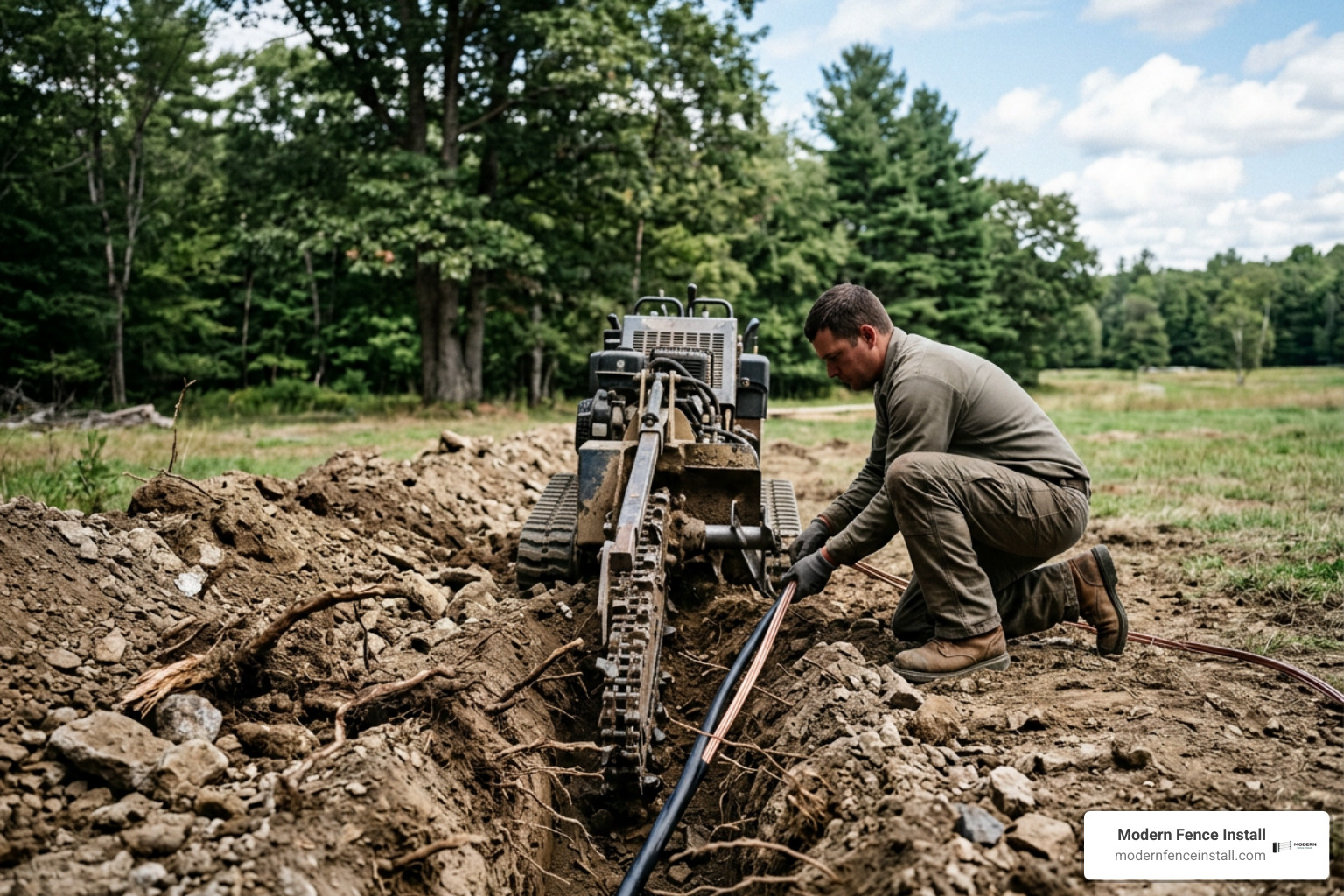
Key technical hurdles to prepare for during a large-scale DIY or professional installation include:
- Trenching Across Complex Terrain: Digging a continuous 1- to 3-inch trench through rocky soil, dense brush, and thick tree roots requires dedicated equipment. Hand-digging several thousand feet is rarely practical; renting a gas-powered mechanical trencher or a dedicated cable layer saves dozens of hours of labor.
- Wire Gauge Selection (14-Gauge vs. 20-Gauge): Never use standard 20-gauge thin wire on large acreage. Heavy-duty 14-gauge solid copper wire with high-density polyethylene jacketing resists degradation from ground moisture, soil shifting, and rocky friction, extending the system's operational lifespan beyond 20 years.
- Waterway and Driveway Crossings: If your perimeter crosses streams, drainage swales, or ponds, the wire must be encased in rigid PVC conduit or anchored with weighted submersion clips. Driveways require cutting expansion joints with a masonry saw or boring conduit beneath the asphalt or gravel.
- Professional Waterproof Splicing: On a multi-acre perimeter, you will inevitably splice multiple 500- or 1,000-foot spools of wire. Using standard electrical tape will cause ground faults within months. Every splice must use silicone-filled, gel-capsule waterproof wire-nut enclosures to prevent corrosion.
Because underground wire systems demand extensive ground disturbance and ongoing maintenance against breaks, many homeowners evaluate non-electric vs electric dog fences to avoid burying electronic components altogether.
Complete Cost Breakdown: Underground Fences vs. Physical Barriers
Investing in a large-acreage containment solution involves both initial setup costs and recurring ownership expenses. While an underground electric fence has a lower initial materials cost than a traditional wooden or chain-link fence, the long-term expenditures of expanding, maintaining, and troubleshooting invisible systems add up over time.
- Base Electronic Kits: Commercial-grade base kits covering 1 to 2.5 acres typically range from $300 to $600 out of the box.
- Expansion Spools and Wire Upgrades: Purchasing 3,000 to 7,000 feet of professional-grade 14-gauge HDPE wire adds $400 to $1,000+ depending on total linear footage.
- Installation Equipment: Trenching machine rentals, masonry blades, PVC conduit, and professional splice kits add another $250 to $600 for DIY installations, while full turnkey professional underground fence installations frequently cost between $2,000 and $5,000 on large acreage.
- Ongoing Maintenance and Collars: Additional receiver collars cost $100 to $250 each. Replacement lithium batteries, surge protectors, and wire-break locator tools contribute to recurring lifetime costs.
Beyond financial costs, the most significant limitation of any underground electric fence is its inability to establish a physical barrier. Electric systems cannot prevent outside threats from entering your property. If your acreage borders wild terrain, understanding whether a fence will stop coyotes, feral dogs, and wildlife is critical to ensuring your pet's true safety.
Frequently Asked Questions About Large Property Dog Containment
How deep should dog fence wire be buried on large acreage?
Boundary wire should be buried consistently between 1 and 3 inches below the soil surface. This depth protects the copper line from lawnmower blades, aerators, utility vehicles, and minor soil erosion while keeping the radio frequency close enough to the surface to communicate with the collar. In heavily wooded, non-trafficked zones, the wire can occasionally be pinned directly to the surface using heavy-duty landscape staples, where leaf litter and organic matter will naturally bury it over time.
Can underground fences handle multiple dogs across 10+ acres?
Yes. Commercial wired systems support an unlimited number of dogs within the containment boundary. Each dog wears an independent receiver collar programmed to their specific size and temperament. For example, a high-drive livestock guardian can wear a collar set to higher progressive correction, while a smaller companion breed on the same 10-acre property can use a low-level static or tone-only profile.
How do you find and fix wire breaks on a multi-acre property?
When a wire break occurs on thousands of feet of buried line, the indoor transmitter emits an audible loop-break alarm. To locate the break without digging up the entire perimeter, you use a radio-frequency wire break locator. This handheld wand tracks the electromagnetic field along the ground and goes silent at the exact point of the break. The damaged section is cut out and repaired using 14-gauge patch wire and silicone-filled waterproof splice capsules.
Conclusion
Finding the right containment strategy for properties spanning 2 acres and beyond requires balancing perimeter reliability, terrain challenges, and overall maintenance. High-capacity underground systems like SportDOG and URPet eXtreme provide dependable, boundary-stable radio containment across large properties when installed with heavy-gauge, buried copper wire.
However, underground radio fences require consistent collar compliance, regular battery charging, manual wire-break troubleshooting, and offer zero protection against roaming predators, deer, or stray animals entering your land.
For property owners throughout Connecticut, New York, and Massachusetts, seeking dependable, long-term containment without the hassle of buried wires, dead collar batteries, or static correction, our team at Modern Fence Install offers a cleaner alternative. We install engineered, low-visibility steel-cable and virtually invisible mesh enclosures that preserve your scenic views while establishing a true physical barrier. Discover our purpose-built, low-maintenance containment with engineered non-electric deer and dog fencing that is pro installed without digging or property disruption, its also low visibility and affordable, booking installation dates now and all of New England.