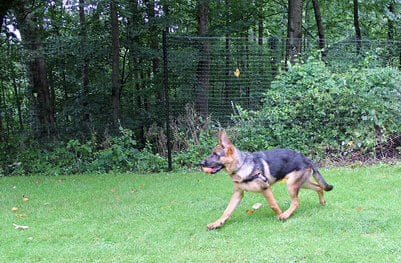
Choose a Coyote Fence That Works in the Woods
A coyote fence for wooded areas should block three common entry methods: jumping, squeezing through, and digging under. Start with a tight, durable mesh fence that is 6 to 8 feet high, leaves no openings wider than 4 inches, follows the ground closely, and includes an outward ground apron or buried L-foot barrier where coyotes could dig.
Wooded lots need extra planning. Clear a narrow fence corridor, remove fallen branches that can create climbing aids, and inspect slopes, roots, and gate gaps. A low-visibility steel-cable or mesh system can protect dogs and gardens without turning a wooded backyard into a solid-wall enclosure.
Coyotes can jump as high as 6 feet and use brush, logs, or uneven ground as helpful footholds. The right fence design accounts for the terrain around it, not just the height of the fence itself.
I am Jason Levine, EMT-B, Senior Consultant at Modern Fence Install, where I help homeowners in CT, NY, and MA plan discreet, non-electric mesh barriers for pets, gardens, and wooded properties. In this guide, I will explain how to choose and maintain a coyote fence for wooded areas that fits your terrain and security needs.

Understanding Coyote Behavior Along Forest Edges
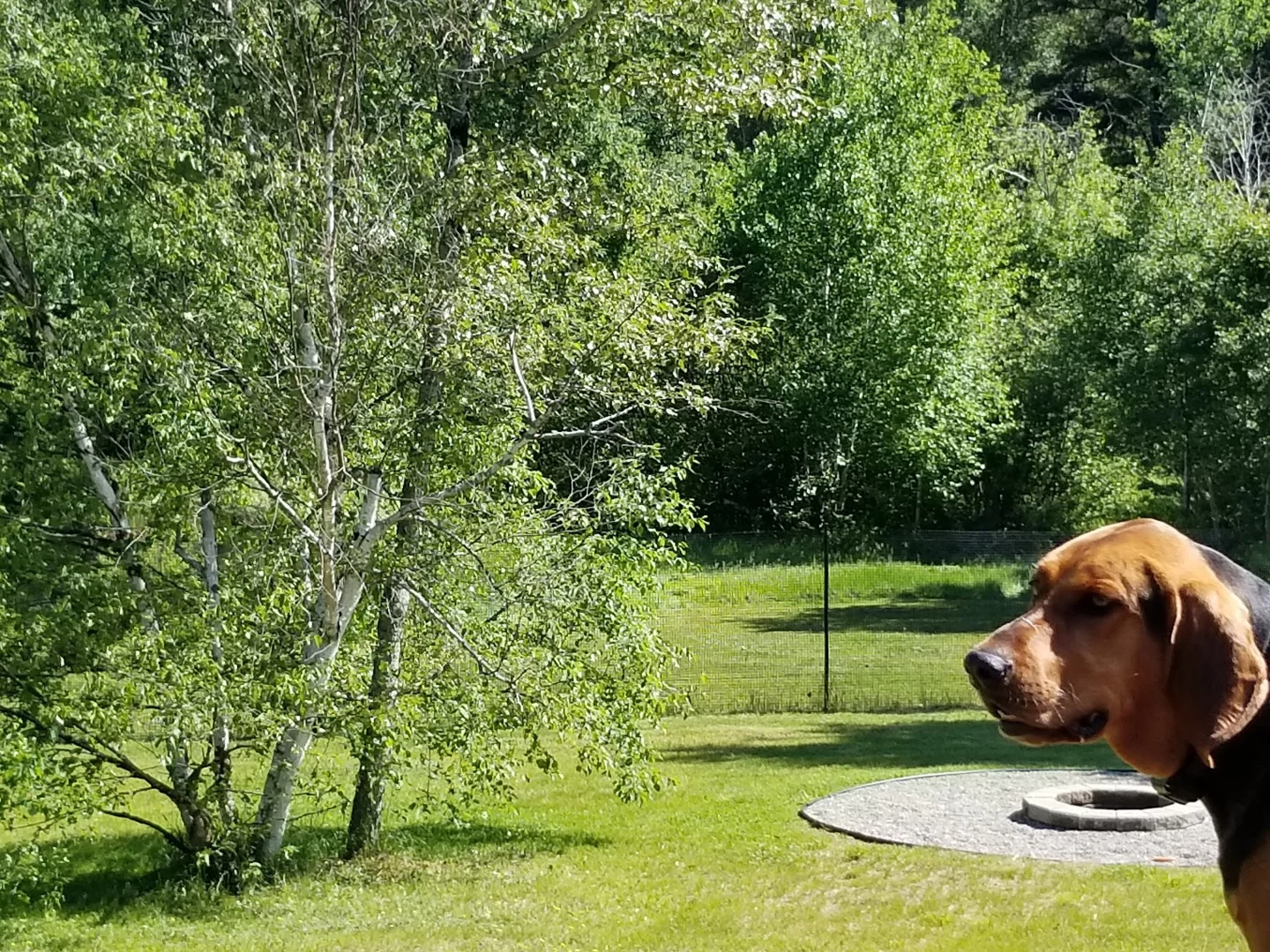
Living next to a forest canopy or dense greenbelt means sharing your ecosystem with intelligent, opportunistic predators. Coyotes thrive along wooded perimeters because natural forest cover provides concealment, established game trails, and rapid escape routes. Understanding their daily patterns and physical capabilities is the first step in planning a long-term physical barrier.
Coyotes are crepuscular, meaning they are most active during dawn and dusk—often the exact hours you might let family pets out into the yard. Unlike domestic dogs, coyotes do not view a fence as a rigid boundary. Instead, they treat it as an obstacle course to solve. If an enclosure presents visual footholds, loose bottom margins, or elevated launch pads, a hungry coyote will test those weaknesses methodically.
Jumping and Climbing Tactics in Dense Brush
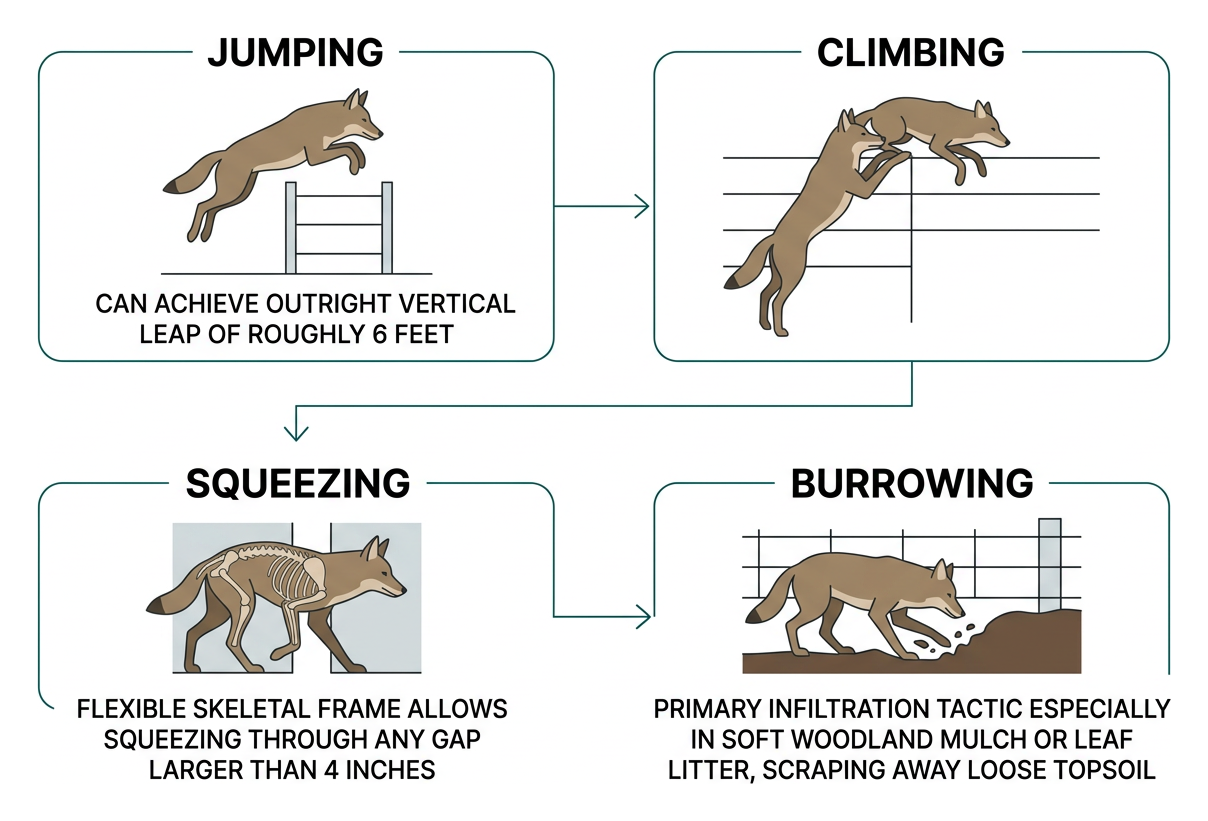
Many property owners assume that coyotes clear high fences cleanly like show horses. In reality, while a healthy coyote can achieve an outright vertical leap of roughly 6 feet, their primary climbing technique is far more athletic. They spring upward, catch the top wire or rail with their front paws, kick their back legs against the fence surface for purchase, and vault over the other side.
In a forest environment, natural features frequently alter this equation:
- Fallen Timber and Boulders: A downed trunk or granite outcropping sitting 3 feet off the ground effectively turns a 6-foot fence into a 3-foot step-over.
- Low-Hanging Canopy: Sturdy oak or maple branches overhead provide perches or launching points.
- Underbrush Footholds: Dense briar patches and mountain laurel beside a fence line give predators leverage to scramble up lower fence sections without touching open ground.
Digging Habits and Squeezing Gaps
If a fence line successfully eliminates jumping opportunities, a coyote will immediately drop its nose to the soil. Subsurface burrowing is a primary infiltration tactic, particularly in soft woodland mulch or leaf litter. Coyotes have flexible skeletal frames and can easily squeeze through any gap larger than 4 inches.
Forest root networks complicate how barriers behave at ground level. Surface roots from mature pines or oaks create rolling humps and hollows. If standard rigid fencing is installed horizontally across these surface contours, wide depressions form beneath the bottom line. Coyotes will exploit these natural pockets in minutes, using their forepaws to scrape away loose topsoil and widen the passage.
Designing an Effective Coyote Fence for Wooded Areas
Securing a forested lot requires an intentional design that balances predator exclusion with landscape aesthetics. A heavy, solid wood privacy fence or industrial chain link often clashes with natural surroundings, blocks scenic woodland views, and requires clear-cutting broad swathes of timber. By contrast, specialized high-tensile steel mesh systems integrate into the forest setting while presenting an impenetrable barrier to wildlife.
Evaluating Material Options for a Coyote Fence for Wooded Areas
Choosing the right material involves evaluating structural longevity, visual impact, and resistance to environmental stress. The following comparison highlights how different fencing styles perform in heavily wooded environments:
| Fence Material Type | Visual Impact in Woods | Resistance to Digging & Squeezing | Resistance to Tree/Branch Impacts | Typical Material Cost (per linear ft.) |
|---|---|---|---|---|
| Engineered High-Tensile Mesh & Steel Cable | Near-invisible; blends into forest understory | High (integrates continuous ground flare / pinned apron) | High (cable absorbs shifting limbs without rigid panel deformation) | $15 – $40 |
| Traditional Wooden Latilla Fence | Rustic, natural woodland appearance | Moderate (requires supplementary wire apron at base) | Moderate (poles can rot or snap under heavy deadfall) | $7 – $11 per pole (materials only) |
| Chain Link (Galvanized or Black Vinyl) | High visual profile; industrial look | Moderate (susceptible to bottom-lifting without bottom rail/apron) | Moderate (rigid top rails bend under falling branches) | $18 – $35 |
| Multi-Strand 3D Electric System | Low visual profile | Low-to-Moderate (requires continuous 8+ kV charge; brush shorts wires) | Low (falling limbs frequently break strands and short power) | ~$1.30 (DIY materials only) |
When homeowners evaluate options, we often discuss the practical trade-offs between physical barriers and energized lines. Reviewing how non-electric vs. electric dog fences hold up against falling branches, leaf litter, and continuous maintenance illustrates why non-electric high-tensile mesh remains the preferred choice for dense forest boundaries.
The Three-Layer Perimeter Defense System
An effective predator barrier does not rely on a single defensive metric. Instead, it combines three distinct structural layers into one continuous system:
- Height and Top-Clearance Defense: The barrier must stand between 6 and 8 feet tall. Because coyotes push off top rails, eliminating horizontal rigid top bars removes paw purchase. For high-activity zones, adding an outward 45-degree angled overhang or rotating coyote rollers prevents predators from getting the grip needed to roll over the top.
- Chew-Proof, Narrow-Aperture Mesh: The main vertical fence body should feature tight grid spacing under 4 inches, constructed from high-tensile galvanized steel or UV-treated composite mesh that withstands gnawing.
- Subsurface / Flare Anti-Dig Apron: To stop excavation, an L-foot wire barrier is fastened to the bottom of the fence and flared outward along the forest floor toward the predator side for 12 to 24 inches, secured with heavy-duty ground stakes.
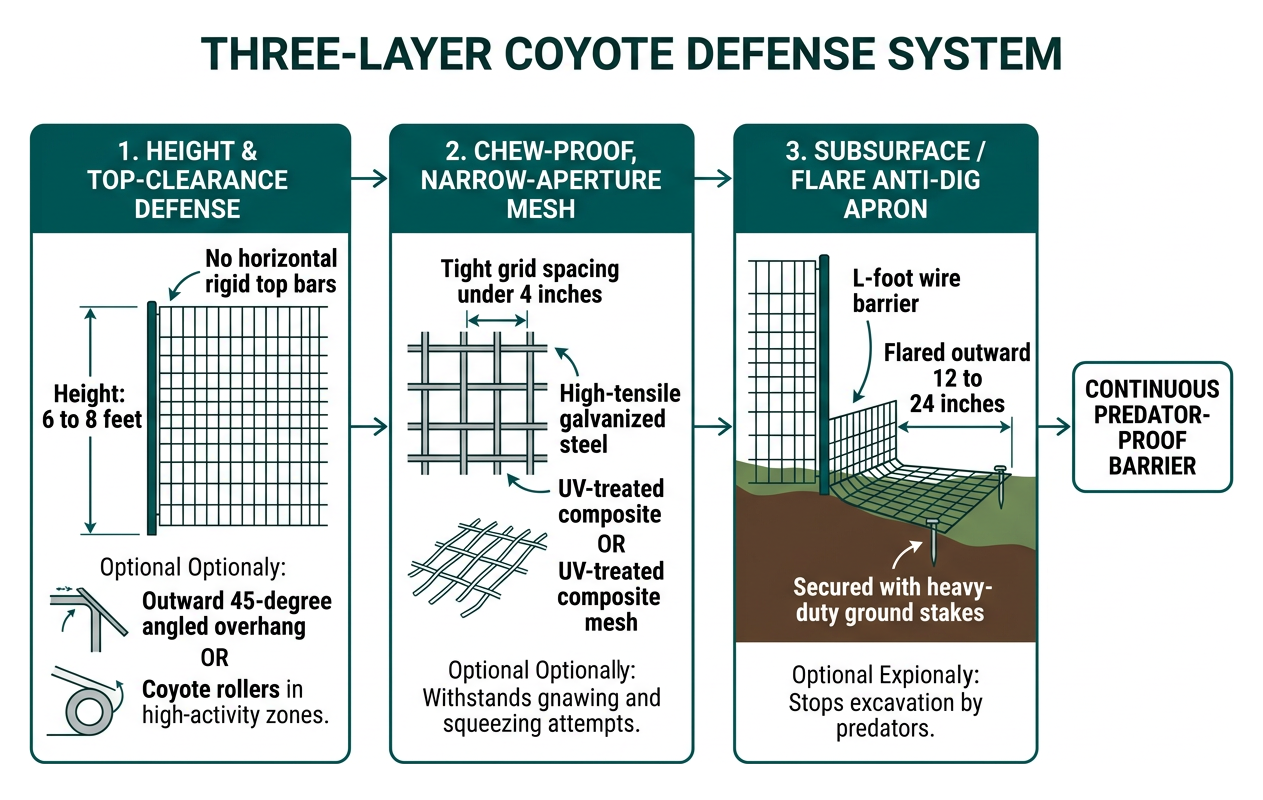
This multi-layer approach ensures that whether an animal attempts to leap, climb, squeeze, or dig, it meets an impassable physical constraint. When planning your perimeter layout, determining the best fence height for large dogs and woodland wildlife helps you balance containment requirements across all species on your property.
How to Build Predator Fencing on Forested Terrain
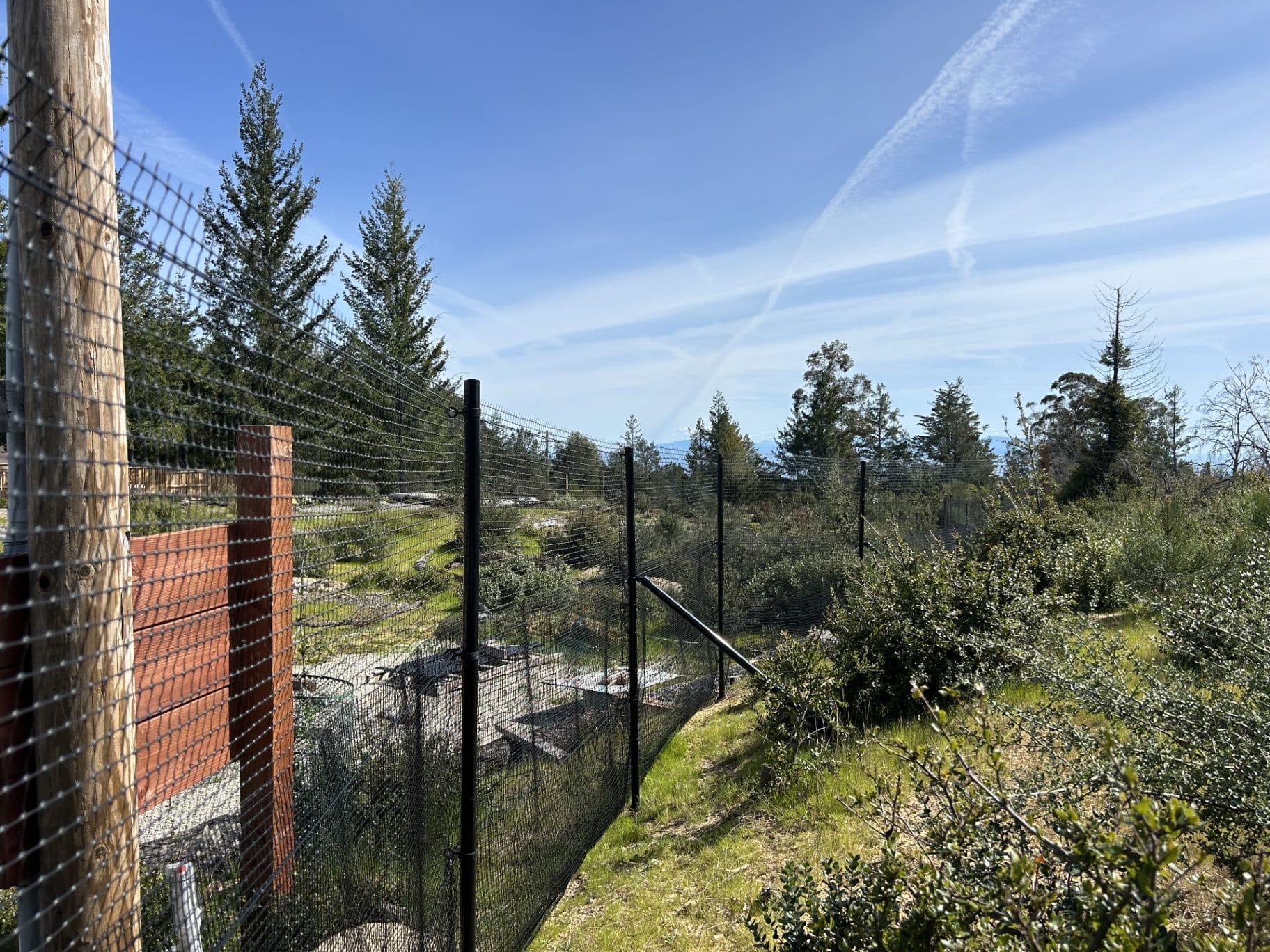
Building a wildlife enclosure across uneven forest terrain presents specific challenges: hidden granite ledges, dense root systems, rolling gullies, and thick tree canopies. Adhering to professional installation practices ensures your barrier remains tight and secure regardless of grade changes.
Site Preparation: Installing a Coyote Fence for Wooded Areas Around Trees
Proper site preparation creates a clean working corridor without compromising the health of the surrounding forest:
- Establish a Clear Path: Clear a narrow 4-to-6-foot corridor along your planned boundary line. Remove invasive briars, dead saplings, and low-hanging canopy limbs under 9 feet.
- Preserve Critical Tree Roots: Avoid bringing heavy trenching equipment through mature tree zones. Cutting structural roots can destabilize valuable forest trees.
- Eliminate Natural Stepping Stones: Move rotten logs, brush piles, and stacked rock outcroppings situated within 6 feet of the outer perimeter to prevent coyotes from using them as launching platforms.
Post Setting and Tensioning Across Uneven Topography
Traditional rigid panels leave gaps when traversing slopes and rolling hills. A high-tensile steel cable system, however, can contour smoothly across rolling terrain:
By tensioning high-tensile steel lines along the forest floor, the mesh flexes over natural ground variations without lifting, maintaining constant downward tension even across sharp dips and knolls.
Securing Ground Anchors and Entry Gates
The ground-to-fence interface is where most amateur installations fail. In rocky New England and Mid-Atlantic soils where deep trenching is impractical, the ground apron provides critical protection:
- Fastening the Apron: Secure the 12-to-24-inch ground flare to the forest floor using heavy galvanized ground stakes spaced every 2 to 3 feet. Over time, falling leaves, pine needles, and natural root growth will knit through the mesh, locking it permanently into the topsoil.
- Zero-Tolerance Gates: Ensure all pedestrian and driveway access gates are built with rigid, non-sagging steel frames. Install an underlying concrete sill, compacted crushed stone header, or buried wire apron directly below each gate leaf to keep bottom clearances under 2 inches.
If your property features steep ravines or extensive rock ledges, partnering with our team for dog fence installation services ensures every contour is fully secured against agile wildlife.
Long-Term Maintenance and Inspection Strategies
A fence through the woods is an active component of a living landscape. Seasonal weather shifts, winter ice storms, and natural forest succession require consistent upkeep to preserve structural integrity:
- Post-Storm Deadfall Checks: Inspect the perimeter after heavy wind or winter snowstorms. High-tensile steel cables are designed to absorb limb strikes without collapsing, but large fallen branches should be cut away promptly to eliminate climbing bridges.
- Seasonal Brush Trimming: Trim back fast-growing wild berry brambles and sapling growth each spring and autumn. Keeping vegetation clear prevents wild vines from pulling down top tension lines.
- Ground Pin and Apron Audits: Check the ground flare along washouts and seasonal runoff streams. Re-pin any stakes displaced by frost heave or burrowing rodents.
- Gate Alignment and Latch Check: Verify that gate latches close flush without sag, keeping bottom gaps strictly below the 2-inch threshold.
Setting up your perimeter with a clear timeline and robust materials makes routine ownership simple. Following an organized 30-day fence installation process guarantees that your woodland layout is built correctly from day one, minimizing ongoing maintenance.
Frequently Asked Questions About Woodland Coyote Containment
How deep should an anti-dig barrier extend in rocky forest soil?
In rocky forest soil where trenching is difficult due to granite ledges and tree roots, the most effective solution is a horizontal ground flare (an L-foot apron) rather than a deep vertical trench. Lay 12 to 24 inches of heavy-gauge galvanized steel mesh flat along the forest floor, extending outward away from the enclosed yard. Secure this skirt firmly with heavy steel ground stakes. Natural leaf litter will bury the wire within a single season, creating an impenetrable barrier against digging claws without damaging delicate tree roots.
Can coyotes jump standard 6-foot wire fences in dense woods?
Yes, coyotes can jump a standard 6-foot fence if they can get traction on a rigid top rail or use nearby natural features as footholds. While an outright vertical leap of 6 feet is at the top of their athletic range, they routinely scramble over 6-foot barriers by gripping the top edge with their paws. In dense woods, fallen logs, rocks, or snow drifts near the fence line reduce the effective jump height. Installing a 7-to-8-foot barrier, removing nearby jumping platforms, and eliminating rigid top rails prevents them from clearing the boundary.
What is the most cost-effective fence design for heavily wooded lots?
The most cost-effective design for forested acreage is an engineered, non-electric high-tensile steel-cable and low-profile mesh system. Traditional solid wood privacy fences or continuous chain link can be expensive to install on steep, rocky woodland grades and require clearing wide swaths of trees. High-tensile mesh systems contour around existing trees and boulders, cut overall project costs by 30% or more compared to solid privacy walls, and preserve the natural visual character of your forest setting.
Conclusion
Protecting your pets, family, and gardens from forest predators does not require turning your wooded property into a fortress of industrial chain link or high-maintenance electric wiring. By understanding coyote agility and installing an engineered, non-electric system featuring appropriate height, narrow mesh spacing, and a secure ground apron, you can maintain an effective physical barrier that blends into the surrounding trees.
At Modern Fence Install, we specialize in custom, low-visibility steel-cable and mesh fencing designed specifically for rocky, uneven, and heavily wooded properties across Connecticut, New York, and Massachusetts. You can find out if a custom fence will stop coyotes on your wooded property by scheduling a professional consultation with our team today. Let us help you secure your boundary while preserving the natural beauty of your woodland home.