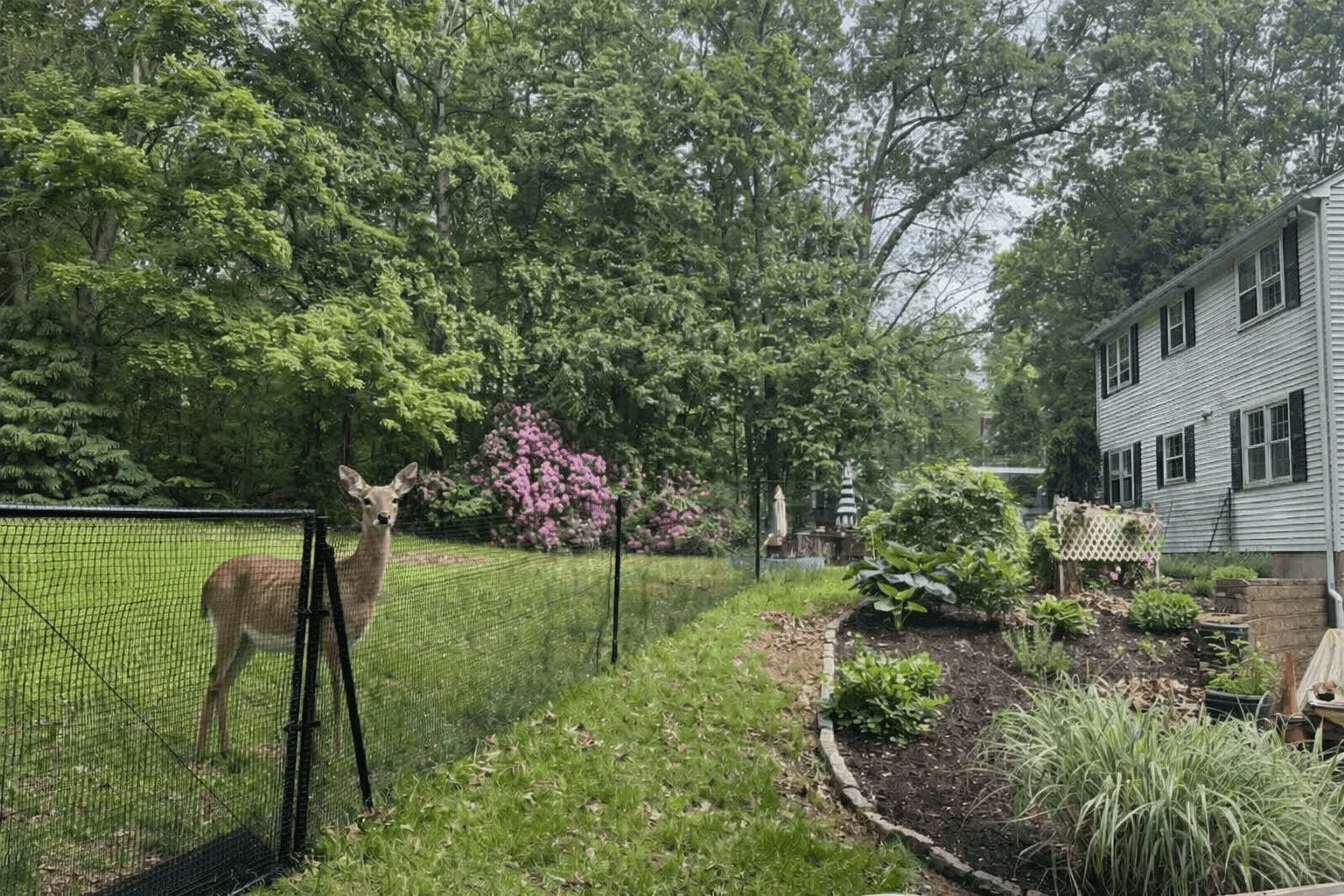
How Deer Behavior Dictates Perimeter Barrier Design
The most effective backyard deer fencing solutions are 7.5- to 8-foot high-tensile poly or steel-cable barriers with ground stakes and bottom flaring, or dual-fence 3D depth spacing that disrupts a deer's landing-zone perception. These engineered systems stop grazing pressure without relying on electricity or solid walls.
Deer are built for agility, yet their survival relies on sharp risk calculation. Understanding this biology helps us design perimeter barriers that exploit their natural instincts rather than relying strictly on sheer brute force.
A deer's primary vulnerability in the wild is injury. A broken leg is fatal to a prey animal, which makes deer exceptionally cautious about their landing zones. The white-tailed deer, the species most commonly responsible for backyard grazing damage across the Northeast, evaluates both vertical height and three-dimensional depth before committing to a jump. If they cannot clearly see where their hooves will land—or if the landing zone looks cluttered, confined, or unstable—they almost always refuse the jump.
This behavior is why a "psychological deer fence" works so effectively. By manipulating a deer's depth perception, you can deter them using creative physical layouts:
- Dual-Fence Layering: Installing two parallel, lower fences (about 4 to 5 feet high) placed roughly 4 to 5 feet apart creates a 3D obstacle. While a deer can clear 5 feet vertically, it struggles to clear both vertical height and horizontal distance simultaneously without a clear landing strip.
- Interior Visual Obstacles: Adding a high-visibility element, such as a taught white line or braided wire strung 3 feet inside the main perimeter at roughly 4.5 feet high, creates a visual hazard. As deer inspect the fence line, the secondary line disrupts their view of the landing zone.
- Multi-Level Perimeter Strands: Running high-tensile wires at 5-foot and 7-foot marks above a baseline physical barrier creates perceived overhead obstacles that deer hesitate to challenge.

Understanding these instincts allows homeowners to successfully protect vegetable gardens from deer and rabbits without turning their backyards into walled fortresses. Furthermore, recognizing that deer rely on visual and spatial cues highlights the benefits of non-electric containment systems over complex, high-maintenance electrified alternatives.
Choosing the Right Deer Fence for Backyards: Engineered System Features
Selecting the proper containment system involves balancing durability, tensile strength, aesthetic impact, and local site conditions. While standard agricultural setups rely on heavy timber posts or high-visibility farm wire, modern residential landscapes require heavy-duty low-visibility deer fence systems that preserve open views.
| Feature / Metric | High-Tensile Steel-Cable Barriers | Low-Profile UV Poly Mesh | Combined Hybrid Systems |
|---|---|---|---|
| Primary Material | Galvanized / Stainless Steel Cable | UV-Stabilized Polypropylene | Steel Cable + Poly / Wire Mesh |
| Expected Lifespan | 20+ Years | 10–15 Years | 15–20+ Years |
| Chew Resistance | Maximum (Impervious to rodents) | Moderate (Requires metal base) | High (Metal base stops chewing) |
| Visual Footprint | Extremely Low (Blends into woods) | Low (Discreet black grid) | Minimal (Near-invisible boundary) |
| Terrain Flexibility | High (Follows contours easily) | High (Easily tensioned) | Superior (Adapts to grades) |
| Best Application | Wooded perimeters & runs | Garden plots & seasonal yards | Full backyard perimeter defense |
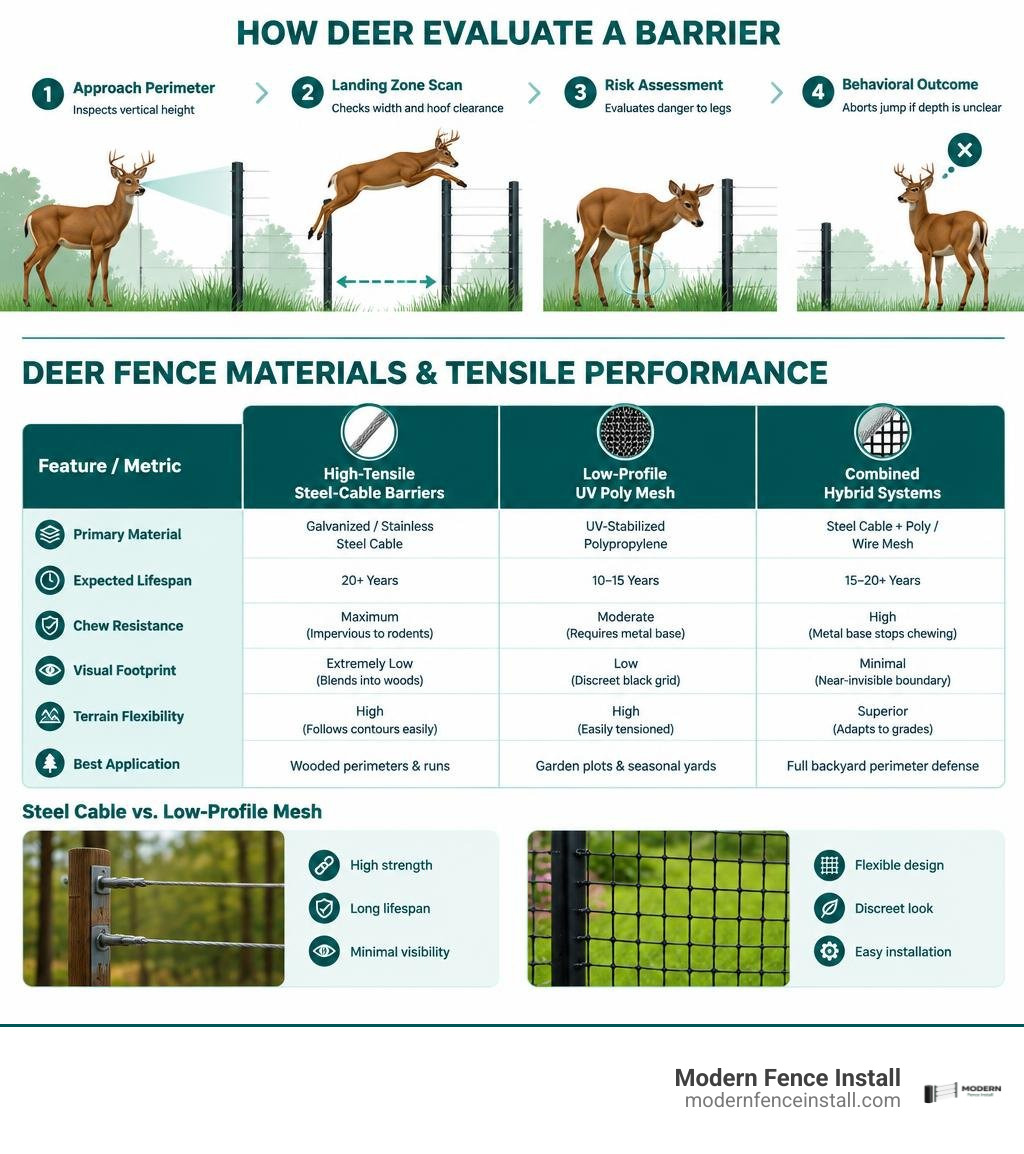
Steel Cable vs. Low-Profile Mesh
When comparing material choices, homeowners generally weigh modern high-tensile steel against flexible black polypropylene meshes.
High-tensile steel cable provides unmatched strength and chew resistance. In areas where rodents, rabbits, or coyotes put pressure on the lower perimeter, steel ensures that the structural core remains intact. For many properties, understanding physical barriers for containment reveals that physical tensile barriers offer complete exclusion without requiring shock collars or frequent wiring repairs.
Low-profile poly mesh, such as standard UV-treated polypropylene, offers an affordable and lightweight barrier that blends seamlessly against tree lines. As noted in university agricultural extension research on deer deterrence, high-strength poly mesh provides dependable seasonal exclusion against foraging pressure. However, for maximum long-term durability, pairing poly mesh with a steel bottom skirt or using galvanized wire along the lower edge prevents smaller pests from compromising the barrier.
How Tall Does a Deer Fence for Backyards Need to Be?
The minimum recommended height for an effective deer barrier is 7 feet, but an 8-foot fence is the gold standard for full perimeter security.
An adult white-tailed deer can clear an 8-foot fence under extreme panic, but in everyday foraging scenarios, they rarely attempt jumping anything over 7 feet unless cornered or driven by severe starvation. Adhering to proper fence height standards is equally important when designing a dual-purpose barrier intended to secure both household pets and ornamental landscaping.
Sloped ground requires special planning:
If the approach to your fence is downhill, a deer standing uphill effectively reduces the barrier's relative height. In these areas, extending the fence to 8 or 8.5 feet prevents deer from clearing the fence from higher ground.
Engineered Deer Fencing vs. Improvised Builds for Garden Beds
Gardeners often start protecting their yards with quick fixes—like hanging plastic netting from wooden stakes, stringing fishing line, or applying foul-smelling sprays. While these tactics can provide temporary relief, they rarely hold up against persistent seasonal deer pressure.
Engineered fencing systems use high-strength drive sleeves, powder-coated steel posts, and structural tension cables to keep the perimeter taut year-round. This setup handles heavy snow loads, falling tree branches, and wildlife impacts without collapsing.
Designing an Aesthetic Deer Fence for Backyards and Raised Beds
A protective barrier shouldn't make your backyard look like a construction zone. Modern installations focus on clean lines and low-visibility materials that disappear into surrounding trees and gardens.
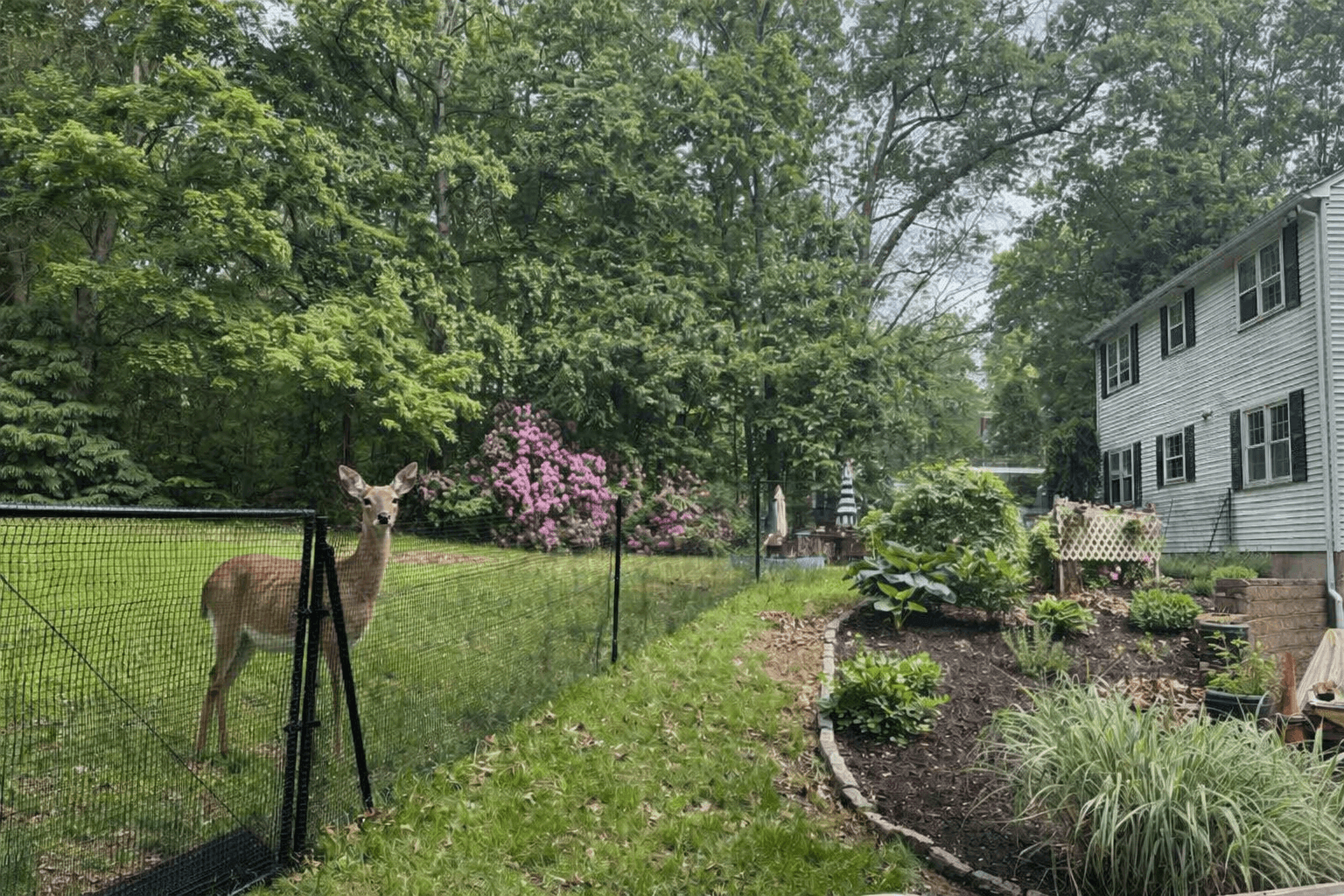
When protecting raised beds, integrating black powder-coated posts with fine-gauge wire mesh preserves sightlines while keeping your vegetables safe. Matching the fence frame to your garden's aesthetic—such as incorporating cedar corner posts or decorative arch gates—keeps the area attractive and functional.
Our installations consistently meet strict neighborhood standards. You can review HOA-compliant fence aesthetics to see how modern, low-visibility barriers protect properties while staying within community guidelines. To explore real-world examples of discreet installations, browse our completed installation design gallery.
Modular Systems vs. Custom Site-Specific Builds
Homeowners typically choose between modular fence kits and custom, site-specific installations:
- Modular Systems: These use prefabricated panels or quick-connect posts mounted into ground sleeves. They are well-suited for rectangular garden plots and allow for seasonal disassembly if you only need protection during the peak summer growing season.
- Custom Site-Specific Builds: Custom builds adapt directly to uneven terrain, rolling hills, dense woodlands, and rocky soil. Continuous tension lines are hand-fitted across the property line, eliminating sags over dips, rocks, and changes in grade.
Total Costs and Critical Installation Features
A deer exclusion fence is an investment in your landscape, garden, and peace of mind. Balancing material choices, line hardware, and installation methods directly affects your total project budget.
For detailed pricing data, permit factors, and material options, check our guide on updated deer fence costs for 2026. If you already have an older barrier on your property, our breakdown on deciding whether to repair or replace an existing garden barrier will help you assess its structural integrity.
When building an effective perimeter, include these essential hardware features:
- Self-Closing Gates: A fence is only as strong as its entryway. Installing spring-loaded hinges or magnetic latches prevents gates from accidentally blowing open or being left unlatched.
- Ground Anchoring Stakes: Deer naturally test the bottom of a fence by pushing with their snouts. Heavy-duty galvanized J-hook stakes every 4 to 6 feet keep the lower edge anchored firmly to the soil.
- Bottom Flare with Rodent Skirt: Flaring the bottom 6 to 12 inches of wire outward along the ground stops burrowing animals from digging underneath. It also provides reliable multi-species perimeter security for stopping coyotes, rabbits, and neighborhood pests.
Frequently Asked Questions About Deer Exclusion Fencing
Can a 6-foot fence keep deer out of a backyard?
In tight or heavily landscaped yards, a 6-foot fence can sometimes deter deer if the interior landing area is narrow, stepped, or filled with raised beds and patio structures. However, across an open lawn or along a downward slope, a healthy adult deer can clear a 6-foot fence with ease. For dependable perimeter protection, we recommend a 7.5 to 8-foot barrier.
How do you secure the bottom of a deer fence against small animals?
To stop rabbits, woodchucks, and smaller critters from squeezing under your fence, install a 2-foot galvanized steel wire mesh skirt (such as 1-inch hexagonal or 1/2-inch hardware cloth) along the base. Flare the bottom 6 to 12 inches outward along the turf and pin it down with heavy-duty steel ground staples. Over time, grass grows up through the flared mesh, locking the skirt firmly into the sod.
How long do heavy-duty low-visibility deer fence systems last?
An engineered system built with powder-coated steel posts, stainless steel tension cables, and UV-stabilized polypropylene or steel-welded mesh typically lasts 15 to 25 years. Because these non-electric systems require no trenching, concrete work, or power, maintenance is largely limited to occasionally checking wire tension and clearing fallen tree limbs after severe storms.
Conclusion
Backyard deer damage does not have to be an annual battle. By installing a thoughtfully engineered, high-tensile deer fence, you can preserve your gardens, ornamental shrubs, and landscaping for decades to come.
At Modern Fence Install, we specialize in high-strength, non-electric steel-cable and low-visibility mesh fencing systems across CT, NY, and MA. Our no-dig, ground-sleeve installation method delivers long-lasting structural strength while saving you 30%+ compared to traditional solid wood or privacy fences—all installed in under 30 days.
Ready to protect your yard? Learn more about our purpose-built deer fence systems, explore our professional deer fencing services in Fairfield County, or get in touch with our installation team.
You can also schedule a consultation or request a competitive estimate review today to design the ideal low-visibility deer barrier for your property.